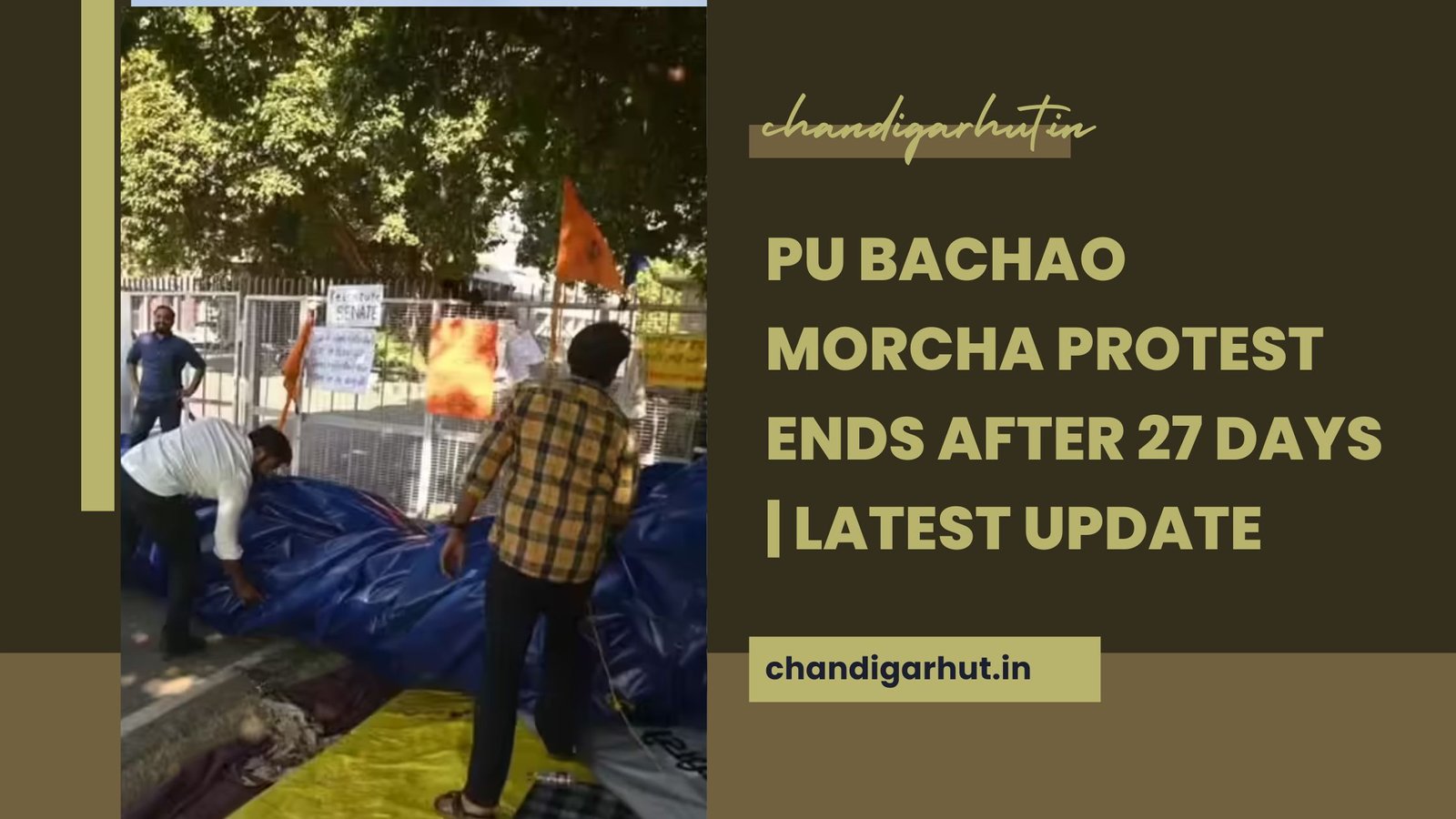
The PU Bachao Morcha protest, which gripped Panjab University for nearly a month, has finally come to an official close. After 27 days of sit-ins, confrontations with security forces, student mobilizations, exam delays, and campus-wide disruptions, the Morcha announced the end of its agitation following written assurances from the university administration.
However, the core issue—the functioning of the Haryana students’ committee—remains unresolved, keeping tensions alive even as normalcy attempts to return to the PU campus.
This comprehensive report covers the timeline, demands, meetings, responses, implications, and what is expected next, with additional FAQs for clarity.
Background: How the PU Bachao Morcha Protest Began
The PU Bachao Morcha protest started in early November 2025, triggered by the reactivation of a committee examining demands raised by Haryana students.
Why Students Protested
The Morcha demanded:
- Immediate scrapping of the Haryana students’ committee
- Withdrawal of pending FIRs against 14 students involved in a 2024 protest
- Review and rollback of new SOPs related to student activities and campus elections
- Restoration of representation and clarity on re-affiliation demands of Haryana colleges
These concerns spiraled into a full-blown agitation, eventually becoming one of the longest student-led protests at Panjab University in recent years.
PU Bachao Morcha Protest: Events Over 27 Days
The 27-day PU Bachao Morcha protest saw various phases—from initial sit-ins to heightened confrontations and eventual negotiations.
Campus Tensions and Police Deployment
Throughout the month-long struggle, the campus saw:
- Deployment of Chandigarh Police, Rapid Action Force (RAF), and Indo-Tibetan Border Police (ITBP)
- Barricading at major student junctions
- Restricted movement around the Administrative Block
- Students being stopped from congregating in large numbers
Security was intensified especially during marches, night protests, and exam days.
Academic Disruptions
The protest resulted in:
- Two rounds of postponed examinations
- Shutdown calls by the Morcha
- Suspension of routine academic and administrative activities
Students on both sides—protesting and non-protesting—reported increased uncertainty regarding classes and exams.
Meetings, Dialogues & Final Written Responses
High-Level Meeting With Punjab University Authorities
On Friday evening, a delegation of 15 Haryana students representing the Morcha met:
- Vice-Chancellor Prof. Renu Vig
- Dean of Students Welfare
- Senior officials involved in committee operations
The meeting lasted more than three hours.
What the University Promised
The university issued three written responses, shared with the delegation.
Committee on Haryana Students’ Demands
The letter stated:
- The Haryana committee has not been scrapped
- It remains functional
- Minutes of the November 17 meeting will be shared on December 1, 2025
- The next committee meeting will be held next week based on member availability
This confirmed that the core demand of scrapping the committee was not accepted.
Withdrawal of FIRs Against 14 Students
Regarding FIRs filed during the 2024 protests near a public event of CM Bhagwant Mann, the university clarified:
- The matter will be forwarded to appropriate legal and administrative channels
- The university itself cannot unilaterally withdraw FIRs
Objections to New SOPs
Students had strongly opposed the updated SOPs relating to:
- Student activities
- Permissions for events
- Conduct of elections
The university said these objections will be placed before statutory bodies for scrutiny and action.
Atmosphere at PU After the Announcement
Dismantling the Protest Site
Following the receipt of the written responses, the Morcha held a brief internal meeting.
They announced the end of their sit-in near the Administrative Block.
By evening:
- Tents were removed
- Posters and banners were taken down
- Supplies were packed up
- Langar services continued until all volunteers dispersed
Mood Shift Due to Senate Election Announcement
Interestingly, the announcement of the PU Senate Election Schedule by the Chancellor’s office earlier this week led to:
- A visible sense of relief
- Celebrations at the protest site
- Renewed discussions about student representation
This announcement played a key role in softening the agitation’s tone.
The Haryana Committee Issue: What Lies Ahead?
Despite the end of the PU Bachao Morcha protest, the Haryana committee remains the central point of contention.
Why the Committee Matters
The committee examines:
- Reinstating representation withdrawn earlier
- Re-affiliation requests from Haryana colleges
- Issues raised by Haryana-based PU students
The Morcha demands the committee be scrapped completely, arguing that it threatens PU’s autonomous structure and may create unnecessary regional divisions.
Current Status of the Haryana Committee After the PU Bachao Morcha Protest
As of now, even after the conclusion of the PU Bachao Morcha protest, the situation surrounding the Haryana committee remains largely unchanged, keeping student concerns alive on campus.
- The committee continues to operate
Despite strong demands from the protesting students to dissolve it entirely, the university administration has clearly stated that the committee remains fully functional. This was one of the central points of contention during the PU Bachao Morcha protest, and its continuation has left many students dissatisfied. - Its next meeting is scheduled after December 1, 2025
The university confirmed that the next round of discussions will take place shortly after December 1, once committee members are available. Students are now waiting to see whether this meeting will bring transparency, fairness, and clarity to the issues raised during the protest. - Students have been told the matter is outside PU’s jurisdiction and lies with higher authorities
Officials informed student delegations that decisions regarding the committee’s existence or dissolution do not fall under Panjab University’s direct authority. Instead, the matter must be escalated to higher governmental or regulatory bodies. This statement was a key reason why the PU Bachao Morcha protest could not achieve a complete victory, leaving students uncertain about the outcomes that lie ahead.
This means tensions may re-emerge if outcomes remain unsatisfactory for either side.
Impact of the PU Bachao Morcha Protest on Campus
Administrative Impact
- Delays in academic schedules
- Repeated exam postponements
- Need for increased inter-department coordination
- Significant expenditure on policing and campus security
Student Community Impact
- Divisions between protesting and non-protesting groups
- Emotional exhaustion among students living on campus
- Increased involvement in student political debates
- Renewed awareness of university governance issues
Long-Term Implications of the PU Bachao Morcha Protest
The PU Bachao Morcha protest may have formally ended, but the debates and questions it has triggered within the academic community are far-reaching and deeply significant. Over the 27 days of continuous agitation, students, faculty members, and administrators were forced to confront structural challenges that have long existed beneath the surface. The protest did not just call for the scrapping of a committee—it opened a broader conversation about governance, rights, and the future of Panjab University.
Student Representation at the Core
One of the biggest issues highlighted during the PU Bachao Morcha protest is the state of student representation within the university.
Students questioned:
- Whether their voices are genuinely considered in policy decisions
- Why committees are formed without consulting student bodies
- Why elected student representatives often lack real decision-making power
The protest rekindled the demand for transparent, consistent, and democratic representation, urging the university to rethink how it involves students in governance.
Need for Administrative Transparency
The agitation also brought the university’s administrative processes into sharp focus.
Protesters repeatedly asked for:
- Clear communication regarding committee decisions
- Transparent sharing of meeting minutes
- Accountability for actions taken without student consultation
The demand for transparency has now become a central expectation. Students want policies to be communicated openly and decisions justified rather than abruptly implemented.
Reconsidering University–State Relations
A major point of discussion triggered by the PU Bachao Morcha protest was the nature of Panjab University’s relationship with:
- The Punjab Government
- The Haryana Government
- The Union Ministries involved
Questions arose about how much influence external governments should have over university affairs. Many students expressed concerns about the possibility of political interference, especially regarding re-affiliation demands and representation issues raised by Haryana colleges.
The protest has therefore opened a wider debate:
Should academic institutions operate with greater autonomy, and how should state involvement be balanced?
Role and Legitimacy of Committees in Decision-Making
The controversial Haryana committee—which sparked the entire protest—led to a deeper discussion on the role, transparency, and accountability of university committees.
Students questioned:
- How these committees are formed
- Whether they represent all stakeholders fairly
- Whether their goals align with the university’s academic and administrative priorities
The 27-day agitation exposed a frustration among students that many committees are perceived as opaque, top-down mechanisms, created without adequate consultation or representation. There is now a louder call for committees to be inclusive, transparent, and reflective of student concerns.
Political Reactions and External Influence
The PU Bachao Morcha protest also saw engagement with politicians, alumni, and student wings across the region.
While political pressure was evident, the final written assurances came directly from PU administration, signaling institutional involvement rather than political mediation.
Possibility of Future Agitation: What Student Leaders Are Saying
Even though the PU Bachao Morcha protest has officially concluded, the sentiment among the core student leaders suggests that the movement is far from over. The end of the sit-in is being viewed as a strategic pause, not a complete withdrawal. Many leaders openly expressed that their primary demands remain unresolved, especially regarding the Haryana students’ committee, which continues to operate despite repeated appeals for its dissolution.
Students Are Not Fully Satisfied
Several student representatives shared that the written responses from the university administration provide assurances but not solutions. They believe:
- The continuation of the committee contradicts the spirit of the negotiations.
- The lack of immediate action on their key demands leaves room for future doubt.
- The administration may be delaying decisions without offering clear commitments.
For the Morcha members, the conclusion of the protest is not a victory, but a temporary step back to reassess strategy.
Monitoring Committee Decisions Closely
Student leaders emphasized that they will be closely observing how the Haryana students’ committee proceeds in the coming weeks.
Their concerns include:
- Whether the committee will genuinely consider Morcha objections
- Whether the minutes released on December 1 will reflect transparency
- Whether student representation will be respected in future proceedings
- Whether higher authorities intervene positively or maintain the current position
Some student leaders even suggested forming a monitoring group to track every decision, meeting, and communication related to the committee.
Possibility of Restarting the PU Bachao Morcha Protest
Perhaps the strongest statement came from multiple Morcha leaders who warned that if the administration fails to deliver substantial, visible progress, the PU Bachao Morcha protest could be revived at any time.
They made it clear that:
- The agitation may return in a larger and more organized form
- Students from Haryana and Punjab could unite again for a joint mobilization
- Examinations and academic activities may be disrupted once more if demands remain ignored
- New protest strategies, including marches, academic boycotts, and digital campaigns, are already being discussed
The message is straightforward:
Ending the protest does not mean the movement has ended.
Unity and Motivation Still Strong
Despite the formal closure of the 27-day sit-in, leaders say that:
- The momentum built during the protest is still alive
- Students remain emotionally invested in the cause
- Any delay or unfavorable decision by the committee could immediately reignite the agitation
- Support networks, volunteer groups, and communication channels are still active
In short, the university administration may have earned time, but not complete peace.
Quiet monitoring has replaced open confrontation—for now.
FAQs
Q1. What was the main issue behind the PU Bachao Morcha protest?
The key demand was the scrapping of the Haryana students’ committee, which protesters believed undermined PU’s autonomy.
Q2. Why did the protest last 27 days?
Lack of clear communication, exam postponements, police deployment, and unresolved demands prolonged the agitation.
Q3. Has the committee been dissolved?
No. The university clearly stated the committee remains functional.
Q4. What about the FIRs against students?
The university will forward the matter to legal/administrative channels, but withdrawal is not guaranteed.
Q5. Are PU exams rescheduled now?
Yes, with the protest ending, regular academic functioning is expected to resume.
Q6. Will student representation issues be addressed?
Objections to SOPs and representation concerns will be referred to statutory bodies for further decisions.
Conclusion:
The PU Bachao Morcha protest may have ended, but the conversation around student representation, Haryana committee operations, and governance reforms is far from over. With the committee still in place and decisions pending, the next few weeks will be crucial for Panjab University’s administrative and political climate.
For students, teachers, and observers, this chapter highlights the importance of dialogue, transparency, and participation in shaping PU’s future.
For more latest and accurate updates on Panjab University protests, Chandigarh news, events, and campus developments, visit:
👉 chandigarhut.in
Stay informed. Stay empowered.