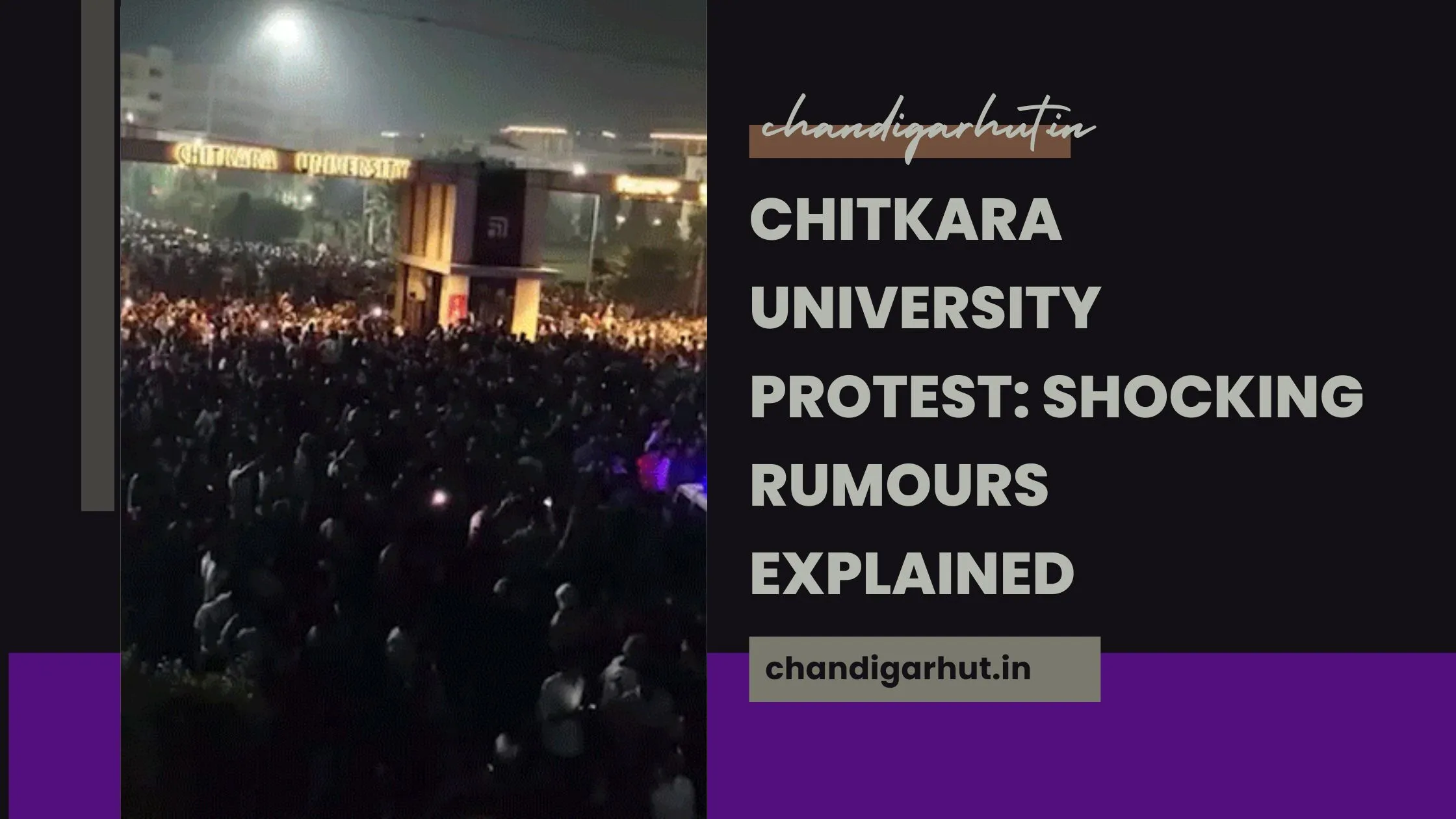
A late-night Chitkara University protest near Rajpura in Punjab’s Patiala district has raised serious questions about how quickly unverified social-media claims can turn into campus unrest. On September 25–26, 2026, hundreds of students reportedly gathered after messages and videos circulated alleging that female students had died or gone missing. Police and university officials subsequently said they found no evidence supporting those claims.
Table of Contents
- Key Takeaways
- What happened during the Chitkara University protest?
- Why did the Chitkara University protest become so tense?
- Did a student actually die at Chitkara University?
- What did Chitkara University Registrar Rakesh Sharma say?
- What did police find about the alleged missing students?
- Why was an ambulance seen at the girls’ hostel?
- What was the “Pandit” or priest story?
- Did the Chitkara University protest involve clashes with police?
- What happened at Chitkara University in 2019?
- What can students and parents learn from the Chitkara University protest?
- What is verified and what remains unverified?
- Why is this Chitkara University protest important beyond the campus?
- What happens next after the Chitkara University protest?
- What is the real-life lesson from the Chitkara University protest?
- Frequently Asked Questions About Chitkara University Protest
- Final Thoughts
Key Takeaways
- The Chitkara University protest followed unverified online claims about deaths and missing female students.
- The university has categorically denied that any suicide or death occurred at the girls’ hostel.
- Police said students could not provide names, photographs or other identifying details of the allegedly missing students.
- The unrest reportedly escalated into damage to police vehicles and campus property.
- A similar false alarm occurred at the university in 2019, but that earlier incident should not be treated as proof of what happened in 2026.
What happened during the Chitkara University protest?
The latest Chitkara University protest began after unverified messages, videos and discussions circulated among students. Reports said the claims involved an alleged death or suicide at the girls’ hostel, while other versions suggested that two female students were missing.
The rumours gained further attention after students reportedly discussed hearing screams and seeing ambulances around the hostel. A separate social-media narrative also referred to a “ghost” on campus and connected it to an alleged earlier death.
However, these social-media claims were not established as facts.
According to police and university officials, verification did not produce evidence that a student had died or that two students were missing.
This distinction is important: what students were discussing online and what authorities were able to verify were two different things.
Why did the Chitkara University protest become so tense?
The Chitkara University protest reportedly developed rapidly because several different claims began circulating simultaneously.
Among the claims discussed online were:
- An alleged student suicide.
- Claims that two female students were missing.
- Reports of screams from a girls’ hostel.
- Videos or messages referring to a “ghost”.
- Questions about ambulances seen at or near the hostel.
- Speculation about a person described online as a “Pandit” visiting the hostel.
- Allegations that the university administration was hiding information.
None of these individual observations, by themselves, established that a student had died or disappeared.
The Times of India reported that police said the episode began with a prank that developed into rumours involving a supposed ghost and missing students.
Did a student actually die at Chitkara University?
Based on the information publicly available as of September 28, 2026, the university and police have denied that a student death or suicide occurred in connection with the rumours that triggered the protest.
Chitkara University issued a clarification saying that no suicide or death had taken place at the girls’ hostel. The university also said that social-media claims were false and lacked factual substantiation.
Hindustan Times reported that Patiala SSP Harmandeep Singh Hans said no suicide or death had been reported by students, families or university authorities. The same report said a senior medical officer at Civil Hospital, Rajpura, reported that no post-mortem examination involving a university student had been conducted in recent days.
Therefore, claims that a student died should not be presented as an established fact.
What did Chitkara University Registrar Rakesh Sharma say?
The university's Registrar, Lt. Col. (Dr.) Rakesh Sharma (Retd.), publicly rejected the claims.
The university's own mandatory-disclosure documentation identifies Rakesh Sharma as its Registrar.
During the controversy, reports quoted Sharma as describing the circulating claims as rumours and saying that no such incident had occurred at the university.
The university also appealed to students and parents not to rely on unverified reels, messages and social-media posts.
“No such incident has taken place at the university. These are all rumours.” — Registrar Col. Rakesh Sharma, as reported by Moneycontrol.
The university's position is significant, but responsible reporting should also acknowledge that the initial allegations came from students and online discussions and that police verification was undertaken after the claims spread.
What did police find about the alleged missing students?
One of the most important aspects of the Chitkara University protest was the claim that two female students were missing.
Police officers reportedly spoke to protesting students to establish who was allegedly missing. According to statements reported by NDTV and other outlets, students could not provide basic identifying information such as the names or photographs of the alleged missing students.
Police nevertheless said the complaint would be examined and that student records could be checked if necessary.
This is a useful distinction between an allegation and a verified disappearance:
| Claim circulating online | Information reported by authorities |
|---|---|
| Two girls were missing | Police said no identities were provided |
| Students had died | University and police denied any death |
| A suicide had occurred | Authorities said there was no such incident |
| Ambulance meant a death had occurred | University gave a different explanation |
| A “ghost” was present | No official evidence established such a claim |
| Administration was hiding deaths | Authorities rejected the allegation |
The table reflects reported positions and should not be interpreted as an independent investigation.
Why was an ambulance seen at the girls’ hostel?
An ambulance became one of the details repeatedly discussed during the Chitkara University protest.
According to the university's clarification, an ambulance did arrive at the hostel in the early hours of September 24. However, the university said it was connected with a student who had returned from hospital and was brought back to her room at around 2:50 a.m.
The university specifically said there was no death or suicide associated with that incident.
This is an important example of why a photograph or video can be misleading when it is shared without its original context.
An ambulance at a hostel can mean many things. Its presence alone does not establish a fatality.
What was the “Pandit” or priest story?
Another detail that became part of the online speculation was the reported presence of a “Pandit Ji” at the girls’ hostel.
According to the university, the person did visit the hostel at approximately 3 p.m. However, the university said he had come to meet his daughter, who was a student there, and that his visit had no connection with an alleged death or suicide.
This again demonstrates how an ordinary event can acquire a completely different meaning when it becomes part of an already circulating rumour.
Did the Chitkara University protest involve clashes with police?
Yes. Reports said the situation escalated beyond a peaceful demand for information.
During the Chitkara University protest, some protesters allegedly damaged police vehicles and campus property. The Times of India reported damage to two police vehicles and said an outpost in-charge was allegedly manhandled.
Hindustan Times also reported damage to university infrastructure and police vehicles during the unrest.
These allegations concerning property damage and confrontations should be distinguished from the original claims about student deaths, which authorities denied.
Police subsequently began looking into how the rumours spread and what happened during the unrest. Reports said no case had been registered against students at the time of publication, although the inquiry was continuing.
What happened at Chitkara University in 2019?
The current Chitkara University protest has a notable historical parallel.
In December 2019, a false emergency call claimed that a female student had died by suicide after being sexually assaulted at the university. Police responded to the call and investigated the claim.
The Tribune reported that police determined the call was a prank made by students.
The Times of India reported that the alleged victim later appeared and clarified that the incident had not occurred. The false claim had already triggered protests and allegations of a possible cover-up before the truth became clear.
The 2019 incident is relevant because it shows that misinformation can previously have produced serious consequences at the same campus.
But it is essential not to confuse the two incidents. The 2019 prank does not independently prove what happened in 2026. The present episode needs to be judged on the evidence available for the present case.
What can students and parents learn from the Chitkara University protest?
The Chitkara University protest highlights a wider problem affecting campuses, hostels and student communities: information can travel much faster than verification.
A message may begin with a genuine concern, but each person who forwards it can unintentionally add another detail.
For example:
Ambulance → student illness → alleged death → alleged suicide → alleged cover-up
By the time the message reaches hundreds of people, the original information may be almost impossible to identify.
For students and parents, a safer approach is to:
- Check whether the university has issued an official statement.
- Contact the concerned student directly.
- Verify claims with police or other competent authorities.
- Avoid forwarding videos with unknown origins.
- Avoid identifying a person as dead or missing without confirmation.
- Separate eyewitness observations from conclusions.
- Preserve original posts if authorities request evidence.
- Allow investigators to establish facts before drawing conclusions.
What is verified and what remains unverified?
The following distinction is particularly important for anyone searching for Chitkara University protest updates.
| Status | Details |
|---|---|
| Reported and verified as an event | Students gathered and protested on campus |
| Confirmed by university | The university denied any death or suicide at the girls’ hostel |
| Reported by police | Claims concerning missing students were investigated |
| Reported | Police vehicles and campus property were damaged |
| Reported online but not established | Claims about a student death or suicide |
| Reported online but not established | Claims involving a “ghost” |
| Reported by university with an alternative explanation | Ambulance visit and priest’s presence |
| Historical fact | A separate hoax triggered unrest at Chitkara University in 2019 |
This is the most responsible way to understand the Chitkara University protest without amplifying unsupported allegations.
Why is this Chitkara University protest important beyond the campus?
The Chitkara University protest is not simply a story about one university. It illustrates the growing importance of verification in an era when WhatsApp groups, Instagram reels and short videos can rapidly shape public perception.
For educational institutions, fast and transparent communication can help prevent uncertainty from escalating.
For students, asking questions is legitimate. But demanding answers and spreading an unverified allegation are not the same thing.
For journalists and digital publishers, the distinction is even more important. A claim involving death, suicide, sexual assault or missing persons can cause enormous emotional harm if published without verification.
That is why this article separates reported allegations, official statements and independently established information rather than treating every viral claim as fact.
What happens next after the Chitkara University protest?
Authorities are expected to examine how the rumours originated and what happened during the unrest.
The university has said academic and placement activities were continuing, while additional security was reportedly deployed as a precaution.
The key questions for any continuing investigation include:
- Who first circulated the death-related claims?
- What was the original source of the video or message?
- Were any students actually reported missing?
- What caused the ambulance visit?
- What happened during the confrontation with police?
- Was university property damaged?
- Will anyone face legal action over misinformation or vandalism?
Until those questions are independently answered, social-media theories should remain theories.
What is the real-life lesson from the Chitkara University protest?
A real-life lesson from both the 2019 episode and the current Chitkara University protest is simple: speed does not equal truth.
In 2019, a prank call led police to the campus and rumours subsequently triggered student protests. In 2026, unverified social-media claims again produced panic and a large gathering before authorities rejected the death-related allegations.
The similarity is striking, but the incidents remain separate.
The safest response when a serious allegation emerges is not silence. It is verification.
Students deserve clear answers. Parents deserve reliable information. And anyone reporting the incident has a responsibility to distinguish what is known from what is merely being claimed.
Frequently Asked Questions About Chitkara University Protest
What is the Chitkara University protest about?
The Chitkara University protest followed unverified social-media claims involving alleged student deaths, suicide and missing female students at the Punjab campus near Rajpura. The university and police denied that a death or suicide had occurred.
Did a student die at Chitkara University?
The university and police said no death or suicide occurred in connection with the rumours that triggered the protest. Claims circulating on social media were described as false or unsubstantiated.
Why did students protest?
Students reportedly gathered after messages and videos circulated about alleged deaths, missing students, screams and other claims. They sought clarification from the university administration.
Were students actually missing?
Police said students raised the allegation that two girls were missing, but protesters could not provide names, photographs or other identifying information for the alleged missing students.
Was there an ambulance at the hostel?
Yes. The university acknowledged that an ambulance arrived in the early hours of September 24 but said it was related to a student returning from hospital and was not connected with a death or suicide.
Was there a police clash during the protest?
Reports said the unrest escalated and some protesters allegedly damaged police vehicles and campus property. Police subsequently began examining the incident.
What happened at Chitkara University in 2019?
A false emergency call in December 2019 claimed that a female student had died after being sexually assaulted. Police investigated and determined it was a prank. The incident nevertheless triggered protests and widespread rumours.
What should students do when they receive an alarming campus message?
Students should verify the information through university notices, police statements or direct contact with the people involved before forwarding it. Serious claims about death or missing persons should never be treated as fact solely because they are viral.
What is the latest confirmed position on the Chitkara University protest?
As of September 28, 2026, the publicly reported official position is that no student death or suicide occurred in connection with the rumours. Authorities have been examining the claims and the unrest, while the university has urged students and parents to avoid unverified social-media content.
Final Thoughts
The Chitkara University protest shows how quickly uncertainty can become panic when serious allegations spread without verification. The available evidence supports reporting the protest, the student concerns, the police response and the university's denial. It does not support presenting the alleged student death or suicide as an established fact.
For Chandigarh, Punjab and the wider student community, the bigger lesson is about responsible information sharing. When emotions are high, verified information matters more than viral claims.
For the latest Chandigarh, Punjab, education, local news and important updates, visit Chandigarh UT for verified and reader-focused coverage.